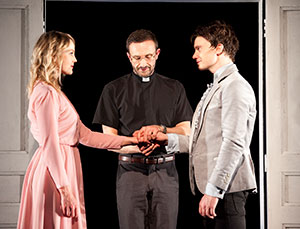
 Left – Eryn Jean Norvill, Mitchell Butel and Dylan Young. Cover – Eryn Jean Norvill and Mitchell Butel. Photos – Lisa Tomasetti
Who but the very tired and jaded can resist the giddy frisson of young love? With the combination of romance, idealism, prejudice and tragedy delivered with glorious poetic language, Romeo & Juliet has rightly been a great favourite with audiences.
A new production of Romeo & Juliet opened on Broadway last week with Orlando Bloom’s Romeo entering the stage on a massive motor bike, immediately stamping his bad boy gang colours on the production. Reviews have been limp with complaints of poor command of Shakespearean language, a lack of spark between the leads and the use of too many visual gimmicks by the director.
The poor New Yorkers! I wish they could see this production instead. This Romeo and Juliet couldn’t be more different. It is not ostentatious in any way, but simple, thoughtful, skilful, genuine, romantic, funny, frightening, thrilling and tremendously entertaining.
The Sydney Theatre Company’s latest production shoots along with exuberance and flair, with a clarity of purpose that sends the audience to interval as chuffed as they could be. Following the interval, as things get more complicated and, ultimately, tragic, the mounting tension builds to a thrilling climax which is different to the original text, but is perfectly in keeping with director Kip Williams’ overarching vision.
Kip Williams’ reading of Romeo & Juliet is both interesting and nuanced and champions a young woman’s right to determine her own future. He focuses less on the idea of Hatfield and McCoy family feud or the Lurhmann/West Side Story notion of gang rivalry in which it is ingrained in every member to despise their familial enemy. Instead, he pits the entrenched rivalry held by the old guard against the new generation who, for the most part, have little regard for historical feuds.
Williams sweeps the audience up in the passion of Romeo and Juliet’s love affair, but in his production, the real complications arise no so much because of the tensions between the Capulets and the Montagues but because of the tension caused by Capulet asserting control over Juliet’s life. This version is about the conflict between father and daughter. Williams has cast his two finest performers in these central roles.
Colin Moody, one of the most electric actors of his generation, delivers a Capulet who is a domineering bully. He is a patriarch used to calling the shots and who brooks no opposition. He is the one who determines who and when his daughter will marry. Moody is both terrifying and despicable. And while he has managed to subjugate his wife (Anna Lise Phillips as Lady Capulet astutely employs an ice cold exterior to hide her own powerlessness), he ultimately fails to force Juliet to submit to his will. The hatred of this one man towards his enemy infects his nephew Tybalt and, ultimately, destroys his daughter.
Eryn Jean Norvill, who matches Moody’s formidable stage magic, is a magnificent Juliet. Norvill’s Juliet is no passive, doe eyed ingénue. Her Juliet is adorable. But she is also smart, strong, serious and eloquent. Norvill is a wonderfully clever and focused actor, whose delivery of some of the most well known theatrical speeches was completely fresh and honest. As the play draws to a close, Norvill’s soliloquies, delivered straight out to the audience, broke everyone’s heart. This is her debut at the STC, but Norvill already has some impressive performances under her belt and, if we are lucky, she might become regular on the Sydney stage.
While Dylan Young’s Romeo is gushy and besotted and swept away with the romance of it all, Juliet, who is equally smitten, is sensible too, checking that Romeo’s intentions are serious and honourable before she throws herself into their romance.
Instead of casting a dashing romantic lead, Williams has chosen Dylan Young, who plays Romeo as a nerdy and awkward hopeless romantic, untainted by antipathies of the family feud. He is an innocent and very much the good boy that Capulet has heard about. When he is caught up in the fight with Tybalt, it is a terrible accident. Romeo is more of a victim of circumstance than someone who is driven by the feud and who willingly entered into the violence.
The opening scene locates the play in an affluent, contemporary milieu. The young folk are part of a rich party crowd. Eamon Farren’s airhead, party boy Mercutio epitomises this. Farren successfully works the comedy in his role, but the seriousness of Mercutio’s commentary of Romeo’s romantic ideas was, at times, sacrificed for the sake of the comedy. Akos Armont’s Benvolio, Mitchell Butell’s morally ambiguous Friar Laurence and Alexander England as Paris all give strong performances.
Julie Forsyth is hugely entertaining as the Nurse and cleverly balances the comic and more serious aspects of her role.
Sound designer Alan John and associate, Nate Edmonson created an eclectic soundscape that underpins the emotional thread of the production and is one of the most sympathetic and creative I have heard recently.
While it is not a beautiful set, it is not unattractive and, more importantly, it really works. Designer David Fleischer’s simple double revolve set perfectly serves Williams’ direction, allowing equally for the large scenes and the numerous smaller exchanges. Fleischer has a liking for decorating the stage with multiples: balloons, pot plants and later, tombs, which is quite striking, although I am still puzzling over why he chose to attach tropical flowers to potted ferns in the scene between Romeo and his father.
The costumes, also by Fleischer, reflect a contemporary wealthy set with the exception of Lady Capulet’s, who perhaps needs to upgrade the quality of her dressmaker, hairdresser and makeup artist to achieve a more polished image in keeping with her position. Lady Capulet is a noblewoman, not an oligarch’s wife. A little more Carla Zampatti or Colette Dinnegan and less Top Shop would probably befit her more.
This is an immensely enjoyable production and Kip Williams’ direction is impressive on many levels. Go see it for Norvill and Moody, who are worth the ticket price all by themselves.
Sydney Theatre Company presents
The Most Excellent and Lamentable Tragedy of Romeo and Juliet
By William Shakespeare
Director Kip Williams
Venue: Sydney Opera House
Dates: 20 Sep – 2 Nov, 2013
Tickets: $95 – $55
Bookings: www.sydneytheatre.com.au
Sydney Reviews
Romeo & Juliet | Sydney Theatre Company
- Details
- Rebecca Whitton
Most read Sydney reviews

The Lark | Hey Dowling
Noni Hazlehurst brings Rose and The Lark to colourful and compelling life in this one-woman show.
Pride & Prejudice* (*sort of) | Neil Gooding Productions & Woodward Productions
This rollicking musical take on Jane Austen’s beloved novel is a side-splitting crowd pleaser.
Heartbreak Hotel | EBKM
Heartbreak Hotel invites its audience into an intimate portrait of the universal and isolating experience of heartbreak.
Current | Sydney Dance Company
While Bonachela’s work is, as always, dreamily lovely, for me the highlights were absolutely the three commissioned choreographers: Azzam Mohamed, Jenni Large and Raghav Handa.
The Gospel According to Paul – The Second Coming | Soft Tread Productions
The Gospel According to Paul is meticulously crafted entertainment. It’s uplifting without pulling any punches.
The Gospel According to Paul is meticulously crafted entertainment. It’s uplifting without pulling any punches.

While Bonachela’s work is, as always, dreamily lovely, for me the highlights were absolutely the three commissioned choreographers: Azzam Mohamed, Jenni Large and Raghav Handa.